
Fire-Resistant Wall Materials: The Ultimate Guide to Building Safer, Code-Compliant Spaces
Fire safety is no longer just an optional upgrade—it is a fundamental part of modern construction and home renovation. Whether you’re building a new home, remodeling an existing property, or upgrading a commercial space, selecting the right fire-resistant wall materials can significantly reduce the spread of flames, protect structural components, and provide valuable time for occupants to evacuate during an emergency.
Today’s building industry offers a wide range of fire-rated materials designed to meet strict safety standards while maintaining aesthetic appeal and energy efficiency. From fire-rated gypsum boards and cement panels to concrete masonry and advanced insulation systems, each material provides different levels of fire resistance depending on its composition, thickness, and certified fire rating. Understanding these differences is essential for making informed decisions that balance safety, performance, durability, and project costs.
It’s also important to recognize that “fire-resistant” does not mean “fireproof.” Fire-resistant wall systems are engineered to withstand fire for a tested period—commonly 30, 60, 90, or 120 minutes—allowing occupants more time to escape and emergency responders more time to control the situation. Their effectiveness depends not only on the materials themselves but also on proper installation, approved assemblies, and compliance with local building codes.
In both residential and commercial construction across the United States, fire-rated wall assemblies are increasingly required in locations such as garages, utility rooms, multifamily buildings, stairwells, and shared walls between dwelling units. Choosing certified products that comply with recognized testing standards helps ensure long-term safety and code compliance while reducing potential repair costs after fire incidents.
This guide explains the most common fire-resistant wall materials, compares their strengths and limitations, discusses where each option performs best, and highlights key considerations such as fire ratings, moisture resistance, sustainability, maintenance, and installation requirements. Whether you’re a homeowner planning a renovation or a contractor selecting materials for a new project, this resource will help you make informed, safety-focused decisions.
Fire-Resistant Wall Materials: Key Takeaways
- Choose certified fire-resistant wall systems rather than relying on individual materials.
- Understand the difference between 30-, 60-, 90-, and 120-minute fire ratings before selecting products.
- Use different fire-resistant materials based on the function of each room, such as kitchens, garages, and utility spaces.
- Proper installation is just as important as the material itself to maintain the wall’s certified fire rating.
- Verify that all products comply with local building codes and recognized fire testing standards.
- Investing in quality fire-rated materials improves safety, durability, and long-term property value.
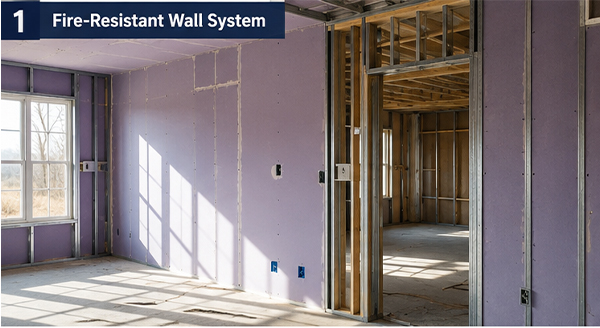
Transform Your Space with BUILPIRE – Book Your Consultation Today!
What Are Fire-Resistant Wall Materials?
Fire resistant wall materials are construction materials specifically designed to withstand high temperatures and slow down the spread of fire. These materials are tested for their fire ratings, which indicate how long they can resist flames before failing. Fire resistance is measured in terms of time, usually ranging from 30 minutes to several hours, depending on the material’s composition and thickness.
Understanding Fire Ratings: What 30-, 60-, 90-, and 120-Minute Fire Ratings Really Mean
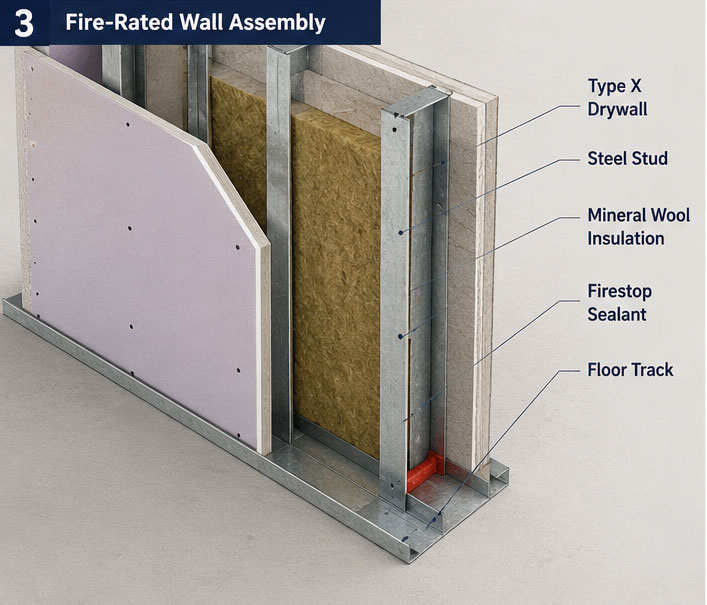
A fire-resistant material is only as effective as its certified fire rating. One of the most common misconceptions among homeowners is assuming that all fire-resistant walls provide the same level of protection. In reality, fire-rated wall systems are tested as complete assemblies, and their performance depends on the combination of materials, installation methods, framing, insulation, and fasteners.
Fire ratings indicate how long a wall assembly can withstand exposure to fire while maintaining its structural integrity and limiting heat transfer. These ratings are determined through standardized laboratory testing and are measured in minutes rather than indicating that a material is completely fireproof.
A fire-resistant wall is only as reliable as the complete wall assembly. Fire ratings are tested on entire systems—including framing, insulation, fasteners, and drywall—not on individual materials. Replacing even one component with a non-approved alternative may void the wall’s certified fire rating.
30-Minute Fire Rating
A 30-minute fire-rated wall is typically used in low-risk residential applications where only a basic level of fire protection is required. These assemblies may be suitable for utility spaces or areas with minimal fire exposure, depending on local building regulations.
60-Minute Fire Rating
A 60-minute fire-rated wall provides enhanced protection and is commonly used between attached garages and living areas, utility rooms, and certain commercial occupancies. It offers additional evacuation time while helping reduce structural damage during the early stages of a fire.
90-Minute Fire Rating
Buildings with higher occupancy levels or greater fire risks often require 90-minute fire-rated assemblies. These systems are frequently installed around stairwells, service shafts, mechanical rooms, and other critical areas where maintaining compartmentation is essential for occupant safety.
120-Minute Fire Rating
A two-hour fire-rated wall is commonly specified in commercial buildings, healthcare facilities, educational institutions, and multifamily residential projects. These assemblies are designed to withstand prolonged fire exposure and are often required where building codes demand maximum passive fire protection.
Why Fire Ratings Matter
Choosing a higher fire rating does not automatically mean better protection for every project. The correct rating depends on your building type, occupancy classification, local fire codes, and the location of the wall within the structure. Installing a system that exceeds or falls short of code requirements can increase project costs or create compliance issues during inspections.
For this reason, builders and property owners should always verify that the selected wall assembly has been tested and certified according to recognized industry standards before installation.
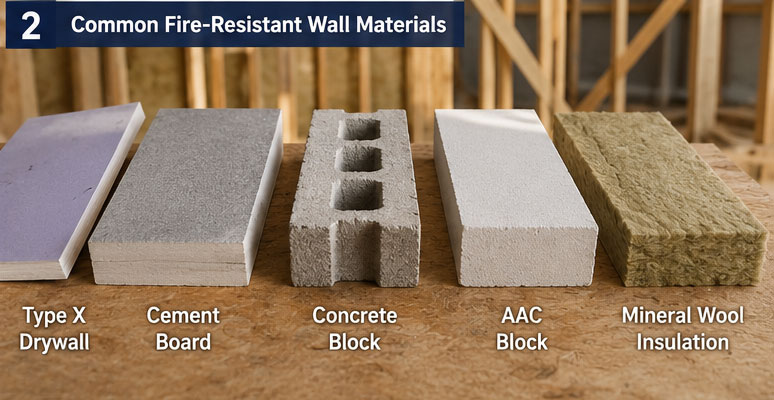
Common Types of Fire-Resistant Wall Materials
- Gypsum Board (Fire-Rated Drywall)
- Contains non-combustible gypsum core
- Available in Type X and Type C variants for higher fire resistance
- Used in residential and commercial buildings
- Cement Board
- Made of cement and reinforcing fibers
- Highly durable and resistant to both fire and moisture
- Ideal for wet areas such as bathrooms and kitchens
- Fire-Rated Bricks
- Manufactured with fire-resistant clay
- Provide excellent thermal insulation
- Used in fireplaces, chimneys, and industrial buildings
- Concrete Blocks
- Composed of cement, sand, and aggregate
- Highly resistant to fire and structural damage
- Suitable for both load-bearing and non-load-bearing walls
- Fire-Resistant Insulation Materials
- Includes mineral wool, fiberglass, and spray foam insulation
- Enhances fire resistance by reducing heat transfer
- Used in walls, ceilings, and floors
- Autoclaved Aerated Concrete (AAC) Blocks
- Lightweight yet strong
- Offers superior fire resistance and thermal insulation
- Ideal for eco-friendly construction
- Fireproof Paints and Coatings
- Can be applied to various surfaces to improve fire resistance
- Forms a protective layer when exposed to high heat
- Common in industrial and commercial settings
| Material | Fire Resistance | Moisture Resistance | Best Applications | Cost Level |
|---|---|---|---|---|
| Type X Gypsum Board | High | Moderate | Living rooms, bedrooms, offices | $ |
| Cement Board | Very High | Excellent | Kitchens, bathrooms, laundry rooms | $$ |
| Concrete Blocks | Excellent | Excellent | Commercial and structural walls | $$$ |
| Fire-Rated Brick | Excellent | Excellent | Fireplaces, exterior walls, industrial buildings | $$$ |
| AAC Blocks | Excellent | Good | Sustainable residential construction | $$$ |
| Mineral Wool Insulation | Excellent | Excellent | Wall cavities, ceilings, mechanical rooms | $$ |
Type X drywall is one of the most commonly specified fire-resistant building materials in residential construction. However, its fire performance depends on proper installation, correct fastener spacing, joint finishing, and compliance with the manufacturer’s tested assembly specifications.
How to Choose the Right Fire-Resistant Wall Material for Every Room
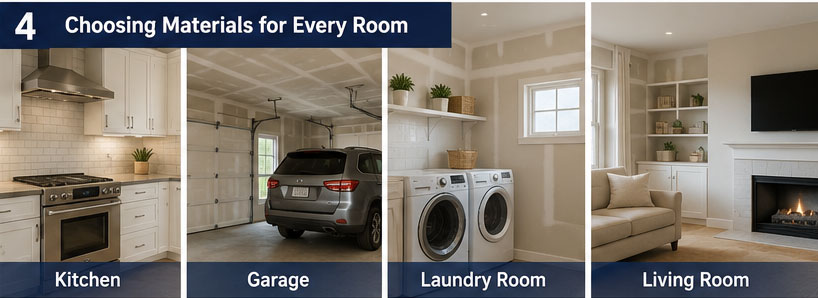
Selecting the best fire-resistant wall material depends on much more than its fire rating. Every area of a building presents different environmental conditions, moisture levels, structural requirements, and safety considerations. Choosing the right material for each room helps maximize protection while avoiding unnecessary construction costs.
Living Rooms and Bedrooms
For most residential living spaces, Type X gypsum board provides an excellent balance of fire protection, affordability, and finish quality. It is widely used in modern homes because it integrates easily with conventional wall systems while offering reliable passive fire resistance.
Kitchens
Kitchens are exposed to higher temperatures, cooking appliances, grease, and occasional moisture. Cement board and fire-rated gypsum board are often preferred because they resist heat while maintaining dimensional stability in demanding environments.
Garages
Attached garages represent one of the highest fire-risk areas in residential construction due to vehicles, fuel, batteries, paints, and stored chemicals. Fire-rated drywall assemblies that comply with local building codes help slow the spread of fire between the garage and adjacent living spaces.
Utility and Mechanical Rooms
Mechanical equipment, electrical panels, HVAC systems, and water heaters increase fire risk. Depending on local code requirements, these spaces often benefit from higher-rated wall assemblies combined with non-combustible insulation materials.
Commercial Buildings
Office buildings, hotels, healthcare facilities, schools, and retail properties frequently require fire-rated wall systems with 60-, 90-, or 120-minute ratings. Designers should always select certified wall assemblies that meet the building’s occupancy classification and local code requirements.
Bathrooms and Laundry Rooms
Moisture resistance becomes just as important as fire protection in these areas. Cement board offers excellent performance because it resists water damage while maintaining its fire-resistant properties over time.
Rather than selecting a single material for an entire project, the safest and most cost-effective approach is to match each wall system to the function and fire risk of the space it protects.
Fire-Resistant Wall Materials at a Glance
| Material | Fire Rating | Moisture Resistant | Residential | Commercial |
|---|---|---|---|---|
| Type X Drywall | ⭐⭐⭐⭐ | ⭐⭐ | ✅ | ✅ |
| Cement Board | ⭐⭐⭐⭐⭐ | ⭐⭐⭐⭐⭐ | ✅ | ✅ |
| Concrete Block | ⭐⭐⭐⭐⭐ | ⭐⭐⭐⭐ | ✅ | ✅ |
| Fire-Rated Brick | ⭐⭐⭐⭐⭐ | ⭐⭐⭐⭐⭐ | ✅ | ✅ |
| AAC Block | ⭐⭐⭐⭐⭐ | ⭐⭐⭐ | ✅ | ✅ |
| Mineral Wool | ⭐⭐⭐⭐⭐ | ⭐⭐⭐⭐⭐ | ✅ | ✅ |
Benefits of Fire-Resistant Wall Materials
Installing fire-resistant wall materials offers advantages that extend well beyond fire protection. Modern fire-rated systems improve overall building performance, increase occupant safety, and contribute to long-term property value.
One of the most significant benefits is slowing the spread of flames and smoke, giving occupants additional time to evacuate while allowing firefighters to respond more effectively. Fire-resistant wall systems also help preserve structural integrity by protecting load-bearing elements from excessive heat.
Many fire-rated materials provide excellent thermal insulation, reducing heating and cooling costs throughout the year. Others improve acoustic performance by minimizing sound transmission between rooms, making them ideal for multifamily housing, offices, and hotels.
From a financial perspective, using certified fire-resistant materials may reduce future repair costs after fire incidents and can contribute to meeting insurance and building code requirements. In addition, many modern fire-rated products are manufactured using sustainable materials that support environmentally responsible construction practices.
For homeowners and commercial property owners alike, investing in high-quality fire-resistant wall systems represents a long-term investment in safety, durability, and building performance.
Factors to Consider When Choosing Fire-Resistant Wall Materials
- Fire Rating: Check the material’s fire resistance duration.
- Installation Requirements: Ensure compatibility with your building’s design.
- Aesthetic Appeal: Some materials offer customizable finishes.
- Moisture Resistance: Consider water-resistant options for wet areas.
- Budget: Evaluate cost-effectiveness based on long-term benefits.
- Environmental Impact: Opt for sustainable and recyclable materials.
- Durability: Choose materials with high longevity and minimal maintenance needs.
Common Mistakes to Avoid When Installing Fire-Resistant Wall Systems
Even the highest-rated fire-resistant materials can lose much of their effectiveness if they are installed incorrectly. Fire resistance is based on tested wall assemblies, meaning every component must work together exactly as specified by the manufacturer.
Using Non-Certified Materials
Choosing materials without recognized fire testing or certification may compromise both safety and building code compliance. Always verify that products have been tested according to recognized fire-resistance standards.
Mixing Different Wall Systems
Replacing one component of a tested assembly with a different product can change the wall’s fire performance. Drywall, insulation, framing, screws, sealants, and joint treatments should be compatible with the certified assembly.
Improper Penetrations
Openings created for electrical outlets, plumbing, HVAC ducts, or communication cables should be properly sealed using approved firestop products. Unsealed penetrations allow flames and smoke to spread rapidly through the wall.
Poor Installation Quality
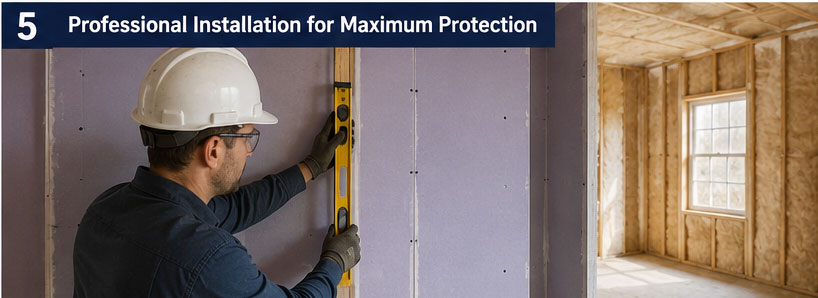
Incorrect screw spacing, damaged drywall panels, unfinished joints, or improperly installed insulation can reduce the wall’s tested fire resistance. Professional installation is just as important as selecting quality materials.
Ignoring Local Building Codes
Fire protection requirements vary depending on occupancy type, building height, location, and room use. Before selecting any fire-rated wall system, always verify local building regulations and applicable code requirements.
Investing in certified products while following manufacturer installation guidelines provides the highest level of protection and helps avoid expensive corrections during inspections.
Applications of Fire-Resistant Wall Materials
- Residential Homes: Enhances fire safety in living spaces.
- Commercial Buildings: Essential for offices, hotels, and malls.
- Industrial Facilities: Used in factories and warehouses.
- Healthcare Institutions: Provides fire protection for hospitals and clinics.
- Educational Buildings: Ensures safety in schools and universities.
- Public Infrastructure: Fire-resistant materials are widely used in airports and government buildings.
Fire-Resistant Wall Materials and Sustainable Construction
Sustainability is a growing trend in modern construction. Many fire resistant wall materials are eco-friendly and contribute to green building certifications. Materials such as concrete, gypsum, and fire-rated bricks offer durability and energy efficiency while reducing environmental impact. Companies are now investing in innovative solutions to develop materials with enhanced fire resistance and lower carbon footprints.
Fire-resistant construction should always be combined with interconnected smoke alarms, early fire detection systems, and a well-planned evacuation strategy. Passive fire protection and early warning systems work together to provide the highest level of life safety.
Official Source: National Fire Protection Association (NFPA)
Conclusion
Fire-resistant wall materials are one of the most effective investments for improving building safety, protecting structural components, and meeting modern construction standards. Whether you’re designing a new home, remodeling an existing property, or managing a commercial construction project, selecting certified fire-rated wall systems helps reduce fire risks while improving long-term building performance.
The right solution depends on your property’s layout, occupancy type, moisture conditions, budget, and local building code requirements. Rather than focusing solely on a material’s advertised fire resistance, it’s essential to choose complete, tested wall assemblies that have been installed according to manufacturer specifications.
At Builpire, we help homeowners and property investors create safer, code-compliant living spaces through thoughtful renovation and high-quality construction practices. Our experienced team can recommend the most suitable fire-resistant materials for your project while maintaining the perfect balance between safety, functionality, and design.
Whether you’re planning a full home renovation or upgrading specific areas of your property, our experts are ready to help you build with confidence.
Schedule your consultation with Builpire today and discover smart renovation solutions designed for lasting protection and exceptional craftsmanship.
For more ideas and guidance, follow us on Instagram.
Frequently Asked Questions
What is the difference between fire-resistant and fireproof wall materials?
Fire-resistant materials are engineered to withstand fire for a tested period, such as 30, 60, or 120 minutes, helping slow the spread of flames and heat. Fireproof materials, in the literal sense, do not exist for most building applications. Even highly fire-resistant materials have performance limits under prolonged fire exposure.
Which fire-resistant wall material is best for residential homes?
Type X gypsum board is one of the most widely used options for residential construction because it provides reliable fire resistance, affordability, and compatibility with standard wall assemblies. Areas exposed to moisture, such as kitchens and bathrooms, often benefit from cement board instead.
How are fire ratings determined for wall systems?
Fire ratings are established through standardized laboratory testing of complete wall assemblies rather than individual products. These tests evaluate how long a wall can maintain structural stability and limit heat transfer during fire exposure.
Can existing walls be upgraded to improve fire resistance?
Yes. Many homes can be upgraded by installing fire-rated drywall, replacing combustible insulation with mineral wool, sealing wall penetrations using approved firestop products, and improving wall assemblies according to current building codes.
Do fire-resistant wall materials increase property value?
Fire-resistant construction can improve a property’s long-term durability, enhance occupant safety, and make the building more attractive to buyers who value resilient, code-compliant homes. While property value depends on many factors, improved safety features are often viewed as a worthwhile investment.